


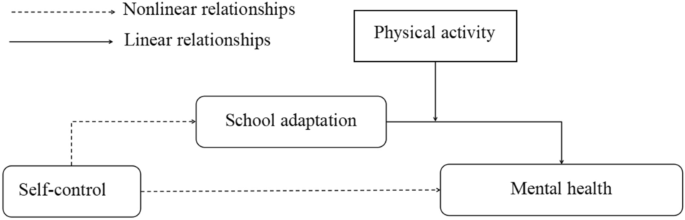
This study found a U-shaped relationship between adolescent self-control and mental health, which differs from the view in previous studies that the two have a linear relationship. Existing findings of the self-control resource depletion theory can partially explain the emergence of the U-shaped relationship between adolescent self-control and mental health. Based on the theory of depletion of self-control resources, scholars have already gained a basic consensus view through different types of research that (1) self-control resources are quite limited, but the depletion of resources is temporary46; and (2) the aftereffect of the depletion of self-control resources is longer, and it takes a longer period of time for the depletion of self-control resources to be recovered47; and (3) effective interventions can help alleviate self-control resource depletion. When individuals are in a state of depletion of self-control resources, they can promote the recovery of self-control resources by improving motivation48, replenishing energy49, and improving the capacity of self-control resources (e.g., following a regular routine, exercising physical strength, and monitoring the use of finances, etc.) through systematic training in everyday life capacity of self-control resources50,51,52, all of which help to mitigate the self-control resource depletion effect. To facilitate readers’ understanding, we assume the existing self-control resources of individual adolescents as water in a reservoir. Based on the above three ideas, we can clarify that the capacity of the reservoir (self-control resource pool) is limited, and when water is needed downstream (when the self-control resource depletion event occurs), the water in the reservoir (self-control resource) is temporarily used. In order to ensure that the water in the reservoir can be used sustainably, the reservoir manager (the individual himself), borrows a river (external self-control resource) upstream to inject water into the reservoir, which in turn is converged by a number of tributaries (different ways of restoring the self-control resource). It takes longer for the river to refill (self-control resource recovery) than for the reservoir to release (self-control resource depletion), so it takes longer for the self-control resource depletion to recover. In the following, we borrow the basic consensus of self-control resource depletion theory to explain in detail how the U-shaped relationship between adolescent self-control and mental health arises.
Firstly, in the decreasing segment of the U-shaped relationship, based on the theory of self-control resource depletion, the study suggests that in the early stages of self-control, continuous depletion of self-control resources can lead to self-control overload, resulting in self-depletion phenomenon and a decrease in adolescent mental health levels. That is, as adolescent self-control levels increase, mental health levels decrease. Faced with the continuous depletion of self-control resources, in order to cope with stressors and maintain mental health, individuals will engage in self-psychological adjustment primarily through defense and coping mechanisms53. Adolescents, in order to overcome the continuous depletion of self-control resources, will stimulate their own psychological defense mechanisms, slow down the depletion of self-control resources, and actively seek ways to restore self-control resources to cope with this depletion. However, at this point, the recovery of self-control resources is still lower than the total depletion, hence self-control and mental health remain in the declining segment of the U-shaped relationship. Brief depletion of self-control resources can be restored to normal levels through rest and other means54.
The example of a reservoir is illustrated in layman’s terms. In the descending section of the U-shaped relationship, the reservoir manager (the adolescent) realizes that water is needed downstream (a self-control resource depletion event occurs), and since the reservoir has sufficient water (self-control resource) at this point in time, the reservoir manager chooses to open the gates and release the water to solve the downstream water problem (the self-control resource begins to deplete). From the downstream viewpoint, the reservoir releases water well, and the downstream water shortage problem is alleviated (i.e., from the outside viewpoint, the level of self-control of the adolescents increases). However, in reality, as more and more water is released, the water in the reservoir has dropped to the warning line (self-control overload), and the entire reservoir system (adolescent mental health), which contains the reservoir (the pool of self-control resources) and the other facilities (the other psychological resources), begins to alarm. That is, the adolescent’s level of self-control increases, accompanied by the continued depletion of self-control resources, and the level of mental health decreases instead. Faced with the alarming status of the reservoir system, the administrator (adolescent) chose to reduce the water release to ensure only the minimum amount of water to address the downstream water problem (defense- and coping-based self-psychological conditioning) due to the cost of time (recovery of self-control resources is longer compared to the depletion of self-control resources). At the same time, the administrator opens the intake valve and borrows a river upstream to fill the reservoir with water (aggressively seeking ways to self-control resource recovery to cope with the depletion of that resource). However, due to the time lag between self-control resource recovery and depletion, the adolescents were able to escape from the continuous depletion of self-control resources by reducing the amount of self-control resource depletion and increasing the amount of self-control resource recovery. However, because of the previous excessive water shortage in the reservoir, at this point, the amount of self-control resource recovery is still lower than the total amount of depletion, and self-control and mental health are still in the declining segment of the U-shaped relationship.
When the depletion of self-control resources reaches a threshold (the lowest point of the U-shaped relationship), where the amount of depletion equals the amount of recovery, the impact of self-control on mental health reaches a turning point. If the recovery rate of self-control resources exceeds the depletion rate thereafter, adolescent mental health levels will improve, showing an upward trend in the U-shaped relationship. This upward trend is consistent with previous research conclusions, where an increase in adolescent self-control levels is associated with higher mental health levels17. Adolescent self-control and mental health exhibit a U-shaped relationship. If, after the turning point, the recovery rate of self-control resources is lower than the depletion rate, the long-term effects of self-depletion become prominent, leading to a qualitative change in adolescent mental health, and potentially the occurrence of psychological problems and even mental disorders55.
The reservoir example is still used for a generalized explanation. In the descending segment of the U-shaped relationship, despite the fact that water inflow > water outflow, the total amount of water inflow < previous depletion + current depletion due to the excessive amount of water shortage in the reservoir previously. Since the administrators (adolescents) have been actively expanding water intake (self-control resource recovery) and decreasing water outflow (self-control resource depletion), the reservoir water volume (self-control resource) always reaches an inflection point, i.e., total water intake = prior depletion + current depletion, at which point the total self-control resource depletion is equal to the amount of water recovered, and the total reservoir volume is no longer continually decreasing, and the health of the entire reservoir system (Mental health) ushered in the inflection point. However, at this time, the health (mental health) of the whole reservoir system still cannot reach the level before the water release (before self-control resource depletion), so the inflection point is the lowest point of the U-shaped relationship, rather than the highest point of the inverted U-shaped relationship. If the rate of water intake (the rate of self-control resource recovery) is faster than the rate of water discharge.
This study found that school adaptation plays a mediating role in the U-shaped relationship between self-control and adolescent mental health. Based on the theory of self-control resource depletion, the U-shaped relationship between adolescent self-control and mental health is related to the dynamic changes in self-control resource depletion and recovery. The theory of self-control resource depletion posits that the execution of all self-control behaviors depletes the energy in the self-control resource pool, and due to the limited total amount of resources, efforts in one area of self-control (such as impulse control, emotion regulation, interpersonal interactions, judgment and decision-making, etc.) will result in reduced energy available in other areas56. The theory of self-control resource depletion can also explain the mediating role of school adaptation. When the total reserve of self-control resources in adolescents is less than the demands of school adaptation, individuals will be in a state of surplus adaptation, where they reluctantly suppress internal needs and strive to adapt to the external environment. As the level of self-control increases, the state of surplus adaptation intensifies, leading to a decrease in adolescent mental health. Meanwhile, to cope with the continuous depletion of self-control resources caused by surplus adaptation, adolescents will alleviate the situation by reducing their level of school adaptation, i.e., under the state of surplus adaptation, the stronger the self-control of adolescents, the lower the level of school adaptation. When the total reserve of self-control resources equals the demands of school adaptation, the “rebound effect” is activated, leading to a significant accumulation of self-control resources in adolescents. With the reserve of self-control resources exceeding the demands of school adaptation, the increase in self-control level triggers an increase in the upper limit of school adaptation, resulting in a positive correlation between self-control and school adaptation in the U-shaped relationship. At this point, adolescent mental health levels increase as self-control levels increase. School adaptation is related to the dynamic changes in self-control resource depletion and recovery in adolescents, mediating the emergence of the U-shaped relationship between adolescent self-control and mental health.
This study found that the relationship between school adaptation and adolescent mental health varies depending on the level of physical activity: when physical activity levels are high, the impact of school adaptation on adolescent mental health is weaker; whereas when physical activity levels are low, the impact of school adaptation on adolescent mental health is stronger. In other words, physical activity can weaken the impact of school adaptation on adolescent mental health, making physical activity a moderating variable between school adaptation and adolescent mental health. Additionally, this study also indicates that while physical activity cannot directly regulate the U-shaped effect between self-control and adolescent mental health, it can regulate the indirect effects between adolescent self-control and mental health through school adaptation. Embodied cognition theory suggests that the concepts and categories through which individuals understand the world around them are determined by their bodies, with abstract concepts such as human progress and decline stemming from the unique physical structure of humans57. Adolescent physical activity can regulate their cognitive perceptions of internal resources and external environments, including their perceptions of self-control and school adaptation. Regular participation in physical activities can enhance self-control resources and school adaptation58,59. Studies have shown that high levels of leisure-time physical activity and moderate levels of work-time physical activity constitute the optimal combination of physical activities to reduce mental health problems60. Physical activity helps individuals break free from the fatigue of daily life, providing time for psychological resource recovery61, and also helps individuals reduce sensitivity to negative external feedback and alleviate mental fatigue62 Extracurricular physical exercise promotes school adaptation and mental health in adolescents63. Compared to adolescents with low physical activity levels, those with high physical activity levels achieve better school adaptation with fewer self-control resources mobilized and are less concerned about mental health issues caused by surplus adaptation.
In general, the results of this study provide the following insights for adolescent educators to maintain the mental health of adolescents: Firstly, dynamically assess the levels of self-control and school adaptation in adolescents. Given the U-shaped effect of self-control on school adaptation and mental health, teachers should pay attention to the compatibility of adolescents’ self-control levels and school adaptation levels. High school adaptation does not necessarily equate to mental health, and surplus adaptation also falls into the category of poor school adaptation. Moreover, “good children” and “obedient children” may exhibit hidden mental health issues. Secondly, the research focus on adolescent physical activity and mental health should be more diverse. While attention is given to the impact of physical activity on the mental health of adolescents with lower levels of self-control and poorer school adaptation, greater emphasis should also be placed on the unique role of physical activity in promoting the mental health of “good children” and “obedient children”. Considering that physical activity can weaken the indirect effects between adolescent self-control and mental health through school adaptation, educators can alleviate the psychological stress of adolescents who fall into a state of “surplus adaptation” due to excessive depletion of self-control resources by guiding them to engage in scientifically effective and diverse physical activities both inside and outside the campus.
link