Assessing the mental health impact of China’s housing boom through national and city-level data analysis
Main results for national-level data analyses
Table 1 presents summary statistics for key variables using National-level data. On average, the annual growth rate of psychiatric outpatient visits (PsychVisits_GR) is 12.5%, with a range from -30.3% to 88.6%, indicating significant variation in mental health responses to housing price fluctuations across provinces. The average house price during the sample period is 6308 RMB per square meter nationwide. The mean value of HRet is 0.117, showing an average annual housing price increase of 11.7%. Local stock market returns (LocalStockRet) averaged 26.3%, meaning investors in companies headquartered in their provinces earned an average return of 26.3%.
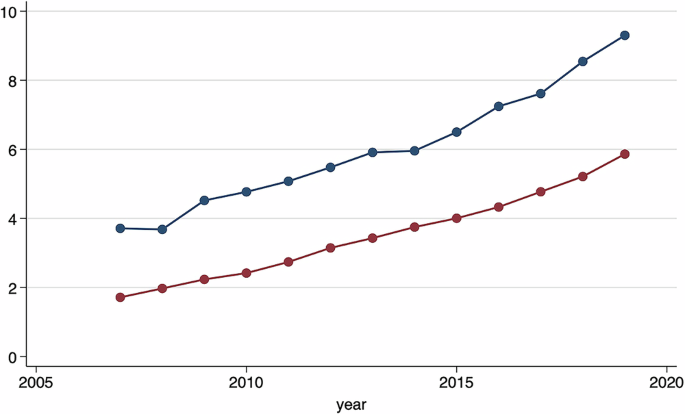
Figure 1 presents a parallel upward trend in both national average house prices and the number of psychiatric outpatient visits from 2007 to 2019. This preliminary evidence supports that at the provincial level, increases in housing prices are associated with a higher number of psychiatric outpatient visits

The figure shows the concurrent rise in national housing prices and psychiatric outpatient visits from 2007 to 2019. The blue line with circles represents average national housing prices measured in thousands of yuan. The red line with circles represents psychiatric outpatient visits measured in tens of millions (divided by 10 for scale).
Table 2 Column (1) presents the main regression result for estimating Model (1). The coefficient on HRet is significantly positive (β1 = 0.0760, p-value = 0.009), indicating that rising housing prices contribute to increased mental stress, reflected in higher psychiatric outpatient visits. When housing prices rise by an additional 1 percentage point, psychiatric visit growth increases by 0.076 percentage point. This result remains robust when stock market returns are included in Model (2). As shown in Table 2 Column (2), the positive association between housing market returns and psychiatric outpatient visit growth persists (β1 = 0.0660, p-value = 0.040). Consistent with prior findings, such as Engelberg and Parsons (2016), stock market returns show a significant but negative effect on mental stress (β2 = −0.0668, p-value = 0.050). This indicates that an 1% increase in local stock returns corresponds to a 0.067% decrease in psychiatric visit growth.
Among control variables, there is a negative serial correlation between PsychVisits_GR and its lagged value (lagPsychVisits_GR) (coefficient = -0.0016, p-value = 0.031), indicating a tendency for mental health visits to decline after an initial surge. PsychVisits_GR is positively correlated with HealthWorker_GR (coefficient = 0.5575, p-value = 0.026) and PsychBeds_GR (coefficient = 0.2121, p-value = 0.026), suggesting that better medical infrastructure attracts more psychiatric patients. Additionally, Gender_FemPct is positively associated with PsychVisits_GR (coefficient = 1.7681, p-value = 0.046), implying that women are more likely to experience mental health issues and seek help. Other control variables are not significant.
Placebo tests for national-level data
Most people tend to purchase homes near their current residence, making them particularly sensitive to local housing price fluctuations. To validate this assumption, we conducted placebo tests. In these tests, the dependent variable remains the same, but we replace the main independent variable, HRet (local housing market returns), with HRet_Other, which represents randomly assigned housing market returns from a different province.
Three different sampling methods were used to construct HRet_Other. In Method 1, we randomly selected housing market returns from any other province. In Method 2, we classified provinces into seven administrative regions (see Supplementary Table 2) and randomly selected housing returns from other regions, assuming that people generally avoid buying property outside their region. However, some residents do buy homes outside their region—for instance, Northeastern residents like purchasing property in Hainan and Hunan residents like buying property in Guangdong. To address this, we adjusted the regional groupings in Method 3 (see Supplementary Table 3). For each method, we conducted 1000 iterations. The simulated percentages of statistically significant coefficients for HRet_Other were 15% for Method 1, 10% for Method 2, and 9% for Method 3. These results suggest that housing price movements in distant regions, where residents have no plans to buy, have minimal impact on local mental health.
Heterogeneous analyses for national-level data
To investigate contextual variation in housing market effects, we classified provinces based on their historical housing price growth ever exceeded the 33.3% annual growth rate threshold during the period of 2008–2019, and re-estimated Model (1). Table 3 displays differential impacts across high-volatility versus moderate-growth regions. Provinces with extreme historical growth exhibit substantial mental health sensitivity to current price changes (β1 = 0.0938, p = 0.001), where a 1% annual housing price increase corresponds to a 0.094% rise in psychiatric visits. In contrast, regions with moderate historical growth show null effects (β1 = − 0.1324, p = 0.268). A coefficient difference test confirms significant inter-group divergence (Δβ1 = 0.2262, p = 0.0104), underscoring the critical role of regional market trajectories in moderating psychological responses.
In line with adaptive expectation theories, this heterogeneity indicates that markets with histories of volatile growth likely amplify stress through three mechanisms: (1) speculative pressures among households anticipating continued appreciation, (2) heightened wealth inequality perceptions, and (3) liquidity constraints from leveraging behaviors. Conversely, stable-growth regions may buffer price shocks through established social norms around housing as consumption (vs. investment) and lower financialization of residential assets.
Further, untabulated cross-sectional results show that residents in regions with higher housing price levels are more vulnerable to psychological stress from price fluctuations. This effect is particularly pronounced in provinces where residents show a heightened interest in housing market information (proxied by Internet searches for housing market), suggesting that increased awareness may amplify stress. Our findings also indicate that single females are more sensitive to housing price changes, highlighting the role of demographic factors like gender and marital status in how individuals respond to housing prices.
For robustness, we used an alternative dependent variable by scaling PsychVisits by the number of residents to control for population size. The main regression and cross-sectional results remained consistent.
Main results for city-level data analyses
Table 4 presents the summary statistics for the City-level sample. The standardized weekly growth rate of house prices (HRetW) was 0.016, while the standardized weekly return for the CSI 300 Index (StockRetW) was 0.031. Weekly visits in logarithm (LogVisitW) were 6.278. To put these numbers in perspective, the actual weekly transaction price for residential houses in Shenzhen averaged RMB 48,924, and the psychiatric department received an average of 562 patient visits each week during the sample period.
Figure 2 visually demonstrates the relationship between average weekly house prices and the number of outpatient visits for individuals diagnosed with mental health disorders during a period of significant housing market volatility (April 1, 2015, to December 31, 2015). The figure shows a distinct pattern, where house price movements appear to lead changes in the number of outpatient visits, suggesting a potential leading effect of housing market volatility on residents’ mental health.

The figure displays the temporal relationship between housing prices and psychiatric outpatient visits using weekly data from Shenzhen, April 1, 2015, to December 31, 2015. The blue line represents logarithmic psychiatric outpatient visits (LogVisitW) shown on the left y-axis. The red line represents logarithmic housing prices in Shenzhen (LogPriceHouseSZW) shown on the right y-axis.
The results from estimating Model (3) are presented in Table 5. First, we test whether future house price fluctuations influence current health outcomes. As shown in Column (1), the results do not support the idea that health outcomes drive the housing market. We then examine the predictability of housing market returns in week t for psychiatric outpatient visits over the next four weeks. Columns (2) and (3) show no significant coefficient for HRetW during week t or t + 1, indicating no immediate impact of housing market returns on psychiatric visits. However, as shown in Column (4), the effect becomes significant two weeks later, with a positive coefficient for HRetW (α1 = 0.0579, p-value = 0.014), suggesting that an 8.271% growth (one SD) in house prices leads to a 5.79% increase in psychiatric outpatient visits two weeks later. However, for the full sample, we fail to find any prolonged increase in outpatient visits of mental illness after week t + 2, as shown in Columns (5) and (6).
To explore the heterogeneity of the effect, we sort the outpatients by gender and age. For age classification, we group individuals into four categories based on housing demand: children and students (0–22), youth (22–45), middle-aged (45–60), and retired individuals (60+). Using LogVisitW_Age(0–22), LogVisitW_Age(22–45), LogVisitW_Age(45–60), LogVisitW_Age(60+), LogVisitW_Male, and LogVisitW_Female as dependent variables, we re-estimate Model (3).
For the Age (0–22) group, house prices show no significant effect on mental health, likely because they do not face immediate housing needs. However, for youth (22–45), housing demand is higher, and they experience mental health pressures from the housing market more quickly. In this group, HRetW is significant and positive in week t + 1 (α1 = 0.0281, p-value = 0.064) and remains significant in week t + 2 (α1 = 0.0463, p-value = 0.038). Middle-aged and elderly individuals (45+) show a greater response to housing market returns in week t + 2, with coefficients of 0.0677 and 0.0566 for the Age (45–60) and Age (60 + ) groups, respectively. This aligns with the cultural tradition in China where older individuals, particularly parents, feel obligated to provide housing for their children, especially in marriage preparation. For the Age (60+) group, HRetW is also significant in week t + 4 (α1 = 0.0333, p-value = 0.084), suggesting that older individuals may receive housing market information more slowly.
In terms of gender, HRetW is significant and positive for both males and females in week t + 2. However, more women than men seek mental health treatment two weeks after house prices rise. This may be due to the higher incidence of psychiatric disorders among women50 or societal norms that discourage men from seeking help for mental health issues51.
City-level analyses by different types of psychological disorders
Table 6 demonstrates differential temporal impacts of housing market returns on different types of psychiatric visits. Sleep disorders show significant positive associations at t + 2 (α1 = 0.0599, p = 0.018), aligning with our baseline regression’s two-week response pattern. Anxiety displays both immediate (t + 2: α1 = 0.0529, p = 0.044) and persistent effects (t + 4: α1 = 0.0341, p = 0.030), consistent with its future-oriented symptomatology. Panic disorders exhibit the earliest response at t + 1 (α1 = 0.1116, p = 0.011), reflecting acute reactivity to perceived threats. Depression manifests rapid onset at t + 1 (α1 = 0.0452, p = 0.045), suggesting immediate emotional processing of financial stressors. These temporal variations reveal distinct psychopathological mechanisms: panic and depression demonstrate acute stress reactivity, while anxiety and sleep disorders show prolonged vulnerability. This has intervention timing implications for mental health services during economic volatility.
Complementary analysis of severe disorders reveals null effects for bipolar disorder and schizophrenia across all lags (p > 0.1), contrasting sharply with depression/anxiety disorders. This supports the clinical distinction between conditions with strong environmental sensitivity (depression/anxiety) versus those with predominant biological etiology (Sullivan et al.48; Kendler et al.49). The divergence underscores a spectrum of environmental vulnerability in psychiatric disorders, where housing market fluctuations primarily affect conditions mediated by psychosocial stress pathways.
City-level analyses by distinct phases of housing market
To examine how housing market conditions moderate mental health impacts, we conducted a temporal analysis leveraging distinct phases in Shenzhen’s housing market: a high-volatility growth period (Pre-2017 Q1) followed by market stabilization (Post-2017 Q1), as depicted in Fig. 3. Table 7 presents comparative results across these epochs.

The figure shows average quarterly logarithmic housing prices (LogPriceHouseSZ) in Shenzhen from 2015 Q1 to 2019 Q1. The blue line represents the trajectory of quarterly average housing prices during this period. Two distinct phases are visible: a high-volatility growth period (Pre-2017 Q1) followed by market stabilization (Post-2017 Q1).
During the volatile pre-2017 period, housing returns showed significant positive associations with mental health service utilization at t + 2 (α1 = 0.0523, p = 0.045), aligning with our primary findings of delayed psychological responses. Post-stabilization, these relationships attenuated to statistical non-significance across all lags (t + 2: α1 = 0.0473, p = 0.172). Between-period differences reached significance (p < 0.05) across temporal windows, confirming market volatility’s moderating role in stress responses.
This temporal heterogeneity reveals two critical insights: First, acute market uncertainty amplifies housing-related psychological strain, likely through mechanisms of financial anxiety and speculative pressure. Second, market stabilization corresponds with effect diminution, suggesting adaptive expectation formation buffers stress responses despite persistent price elevations. These findings underscore that psychological impacts of economic factors depend fundamentally on market context-rapid valuation shifts and instability prove more consequential than absolute price levels. The results advance understanding of temporal boundaries in stressor adaptation and carry implications for mental health resource allocation during economic transitions.
Controlling the stock market influence for city-level data analyses
To assess robustness, we estimate Model (4) with concurrent inclusion of HRetW and StockRetW, testing whether housing market effects persist after controlling for equity market dynamics in Table 8. We conduct this analysis for both the full sample and the subsample of local residents (LogVisitW_Local) the latter group captures visits by local Shenzhen residents (identified through healthcare insurance coverage).
Table 8 demonstrates that HRetW retains significant positive coefficients at t + 2 in both samples (full sample: α1 = 0.0619, p = 0.013; local sample: α1 = 0.0605, p = 0.017), confirming H1’s prediction of housing price effects on mental health utilization. Concurrently, StockRetW exhibits immediate negative effects in week t, e.g., in the full sample α2 = − 0.0208 (p = 0.090), where a one-SD CSI 300 decline (−3.23%) corresponds to a 2.08% visit increase—consistent with Engelberg & Parsons’ (2016) findings but demonstrating smaller magnitude than housing market impacts34. The negative effect of the stock market return is stronger for Shenzhen local residents’ mental health disorders, as in the subsample of local residents α2 = − 0.0238 (p = 0.050).
Crucially, the temporal dissociation between financial market effects—stock returns impacting mental health contemporaneously versus housing returns acting at t + 2—provides robust support for H2. This aligns with our information diffusion framework: real-time stock price visibility enables immediate psychological reactions, whereas housing market responses lag due to slower price discovery through infrequent transactions and delayed reporting. These results substantiate our prediction that housing market fluctuations predict mental health outcomes with delayed responsiveness compared to stock markets, reflecting China’s distinct socioeconomic context where real estate constitutes both wealth storage and social stability anchor.
link