Group heterogeneity in the relationship between physical health level and psychological depression in college students
In this study, a random sampling method was used to distribute questionnaires and collect data from 1,367 first-year students studying in Shandong Province, China. The survey involved the distribution of 1,367 questionnaires, and after the consistency test to eliminate blanks, too much missing data or questionnaires with obvious contradictions before and after answering the questions, 1,312 valid questionnaires were retained, with a validity rate of 95.98%. Among them, 859 (65.5%) were male and 453 (34.5%) were female. All participants were informed of the purpose and confidentiality measures.
Inclusion criteria: ①First-year students enrolled in colleges and universities; ②Informed consent and voluntary participation in filling out the questionnaire; ③Good comprehension and expression ability, reading and writing ability. Exclusion criteria: ①those who are not willing to cooperate with the completion of the survey; ②Errors in the questionnaire, such as incorrect filling, omissions, obvious patterns in the answers, or the same responses from the same respondent.
This study was approved by the Science and Technology Office of the Science and Technology Division of University of Jinan (No.2025000096). Before the questionnaire survey, the participants were informed of the survey plan, the survey content and the research purpose, and signed the informed consent form. After agreeing to participate in the questionnaire survey, the formal survey began.
Physical fitness level
In existing studies, indicators such as BMI, sprint running, sit-and-reach test, and sit-ups are commonly used to assess the physical health or physical fitness level of the subjects1718. For instance, the sit-and-reach test is often used to measure the flexibility of the subjects, and sprint running is commonly used to test the explosive power of the subjects, etc. Therefore, when clustering the “physical health level” of college students, this study selected the Chinese “National Student Physical Health Standard”, which includes the above representative test items, for subsequent test research.
The data source of college students’ physical fitness level was the data of college students’ physical fitness scores tested using the Chinese National Student Physical Fitness Standard as a guideline19. The standard comprehensively evaluates students’ physical fitness level from the aspects of body form, body function and physical quality, which is an educational means to promote the healthy development of students’ physical fitness and to motivate students to actively engage in physical exercise, and the content of the test includes: (1) BMI index in the part of body form, (2) Vital capacity in the part of body function; (3) 50 meters, seated body flexion, boys’ pull-ups and 1000 meters run, and girls’ sit-ups and 1000 meters run, and girls’ sit-ups. meter run for boys, and sit-ups and 800 meter run for girls.
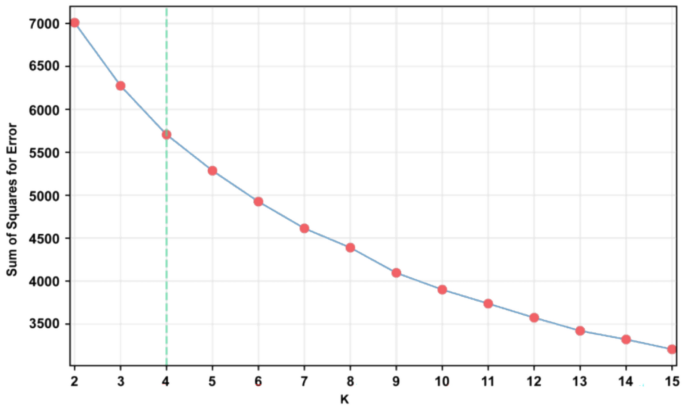
The physical fitness test for college students includes various test items. To ensure the consistency of the score units for all types of items, this study conducted score definition and conversion based on the scoring standards defined in the “National Student Physical Fitness and Health Standard of China”. Then, cluster analysis was further carried out. Therefore, the test data of each item do not need to be standardized again in the subsequent analysis.
Depression
For the measurement of depression level of college students, this study used the Chinese version of The Centerfor Epidemiological Studies Depression Scale (CES-D) revised by Zhang et al.20. The scale was developed by Radloff21 and consists of 20 question items, of which questions 4, 8, 12, and 16 are reverse scored on a four-point Likert scale, with scores of 0−3 indicating, respectively, “less than 1 day per week,” “1–2 days per week “, “3–4 days per week” and “5–7 days per week”. The scale is primarily used to assess an individual’s recent depressed mood and experience, and is less related to the physical symptoms of depression than other depression self-assessment scales, making it more applicable to the general population, such as college students. The higher the total score of all the items of the scale, the higher the depressive mood. Since the Chinese version of this scale has undergone confirmatory factor analysis during its revision process, the analysis results support the original scale’s 4-factor structure. Moreover, the Cronbach α coefficient of this scale in the current sample is 0.89, and the KMO statistic is 0.921. The reliability and validity are good. Therefore, no confirmatory factor analysis was conducted on the current sample in this study.
Statistical analysis
A database was established in Excel software using manual entry and online export of data. SPSS 24.0 software was used for statistical analysis, and the feasibility of cluster analysis was tested by multiple linear regression, and the chi-square test was performed on the clustering results and the depression level. The research results show that p<0.05, which proves that the chi-square test is statistically significant.
link