Longitudinal associations between 24-hour movement behaviors and physical fitness in preschoolers: a compositional isotemporal substitution analysis
Study design
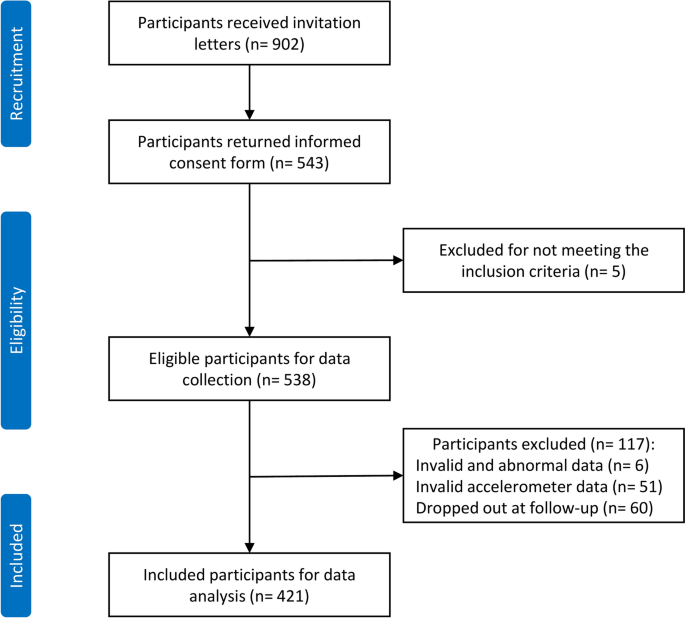
This is a prospective cohort longitudinal study and adopted convenience sampling. This study was conducted under the Strengthening the Reporting of Observational Studies in Epidemiology (STROBE) reporting guidelines. Ethical approval was obtained from the Research Ethics Committee of Beijing Normal University-Hong Kong Baptist University United International College. Signed consent forms were obtained from the kindergarten and parents before the study. Baseline data collection was carried out from October 2021 to December 2021, and two-year follow-up data collection was conducted from October 2023 to December 2023. The kindergartens provided children’s socio-demographic data such as the date of birth and gender.
At baseline assessment, anthropometric data were measured in the kindergarten activity room, followed by PF tests. Children were given a 2-min break between each test to minimise fatigue. All assessments were administered in the same order by the same assessors. The assessors had at least 5 years of experience in preschool children’s anthropometric and PF testing and completed a two-hour supervised training. Questionnaires were taken home by the children and completed by their parents on the assessment day. Accelerometers were placed on the children, who wore the monitors for seven consecutive days. The follow-up phase implemented the same assessment methods, device settings, process, and measurement protocol as the baseline phase.
Participants
From July 2021 to September 2021, formal invitation letters were sent to the administrators of the 45 registered kindergartens in Zhuhai, Guangdong Province, China. The study objectives, procedures, and expected contributions from the participating kindergartens were outlined in the invitation letters. Four kindergartens agreed to participate in this study. The inclusion criteria were: (1) children aged three to four years old, (2) typical developing children (i.e. they were not diagnosed with developmental, neurological disorders, gastrointestinal, or other chronic diseases that could impact a child’s health, physical abilities, or cognitive functions) based on parent report and school records25,26; and (3) would not transfer or drop out of kindergarten during data collection.
Measures
At baseline, participants’ anthropometric data, 24-h movement behaviors, and PF were measured. At the two-year follow-up, participants’ 24-h movement behaviors and PF were measured to track the association between 24-h movement behaviors and PF components.
Anthropometric measurements
Height and weight were measured with a stadiometer (Seca) and weight scale (Wujin, RGT-120), while the participants were barefoot and lightly clothed. Body mass index (BMI) was calculated by dividing body weight by the square of height (kg/m2).
Movement behaviors
PA was measured using the accelerometer (ActiGraph, GT3X-BT, Pensacola, FL, USA), which is a valid, cost-efficient, and widely used tool to assess PA levels in preschoolers 27. The kindergarten teachers and parents received written and video instructions for the usage and placement of the accelerometer. Parents were asked to register an activity diary for both wear and non-wear time. Participants wore the accelerometer on the right hip to monitor all activities for seven consecutive days, except during periods of sleep and water-based activities. The ActiLife software (version 6.13) was used for device initialization, data reduction and data analysis.
A recording epoch of 15 s was used, and valid wear time was considered to be at least 8 h of wear time over at least three days (two weekdays and one weekend day). Non-wear time was defined as 20 consecutive minutes of zero count/minute. Accelerometers were initialized at a sampling rate of 30 Hz and then reintegrated into 60-s epochs for analysis28,29. Time spent in different intensity domains was categorized using the cut-off points according to Butte et al.: sedentary: < 819 counts per minute (CPM); light: 820–3907 CPM; moderate: 3908–6111 CPM; and vigorous: ≥ 6112 CPM30.
SSB and NSB were measured using the leisure-time sedentary behaviors questionnaire (LTSBq)31. Parents were asked to report the frequency and duration of their child spent in SSB (e.g., watching TV; playing with a mobile phone, tablet, or electronic games; and using a computer) and NSB (e.g., reading, writing, or drawing and playing with toys) on weekdays and weekends. The average SSB and NSB time per day over the week was calculated respectively.
Parents were asked to report their child’s daily sleep time using the questionnaire. They needed to recall the children’s average sleep hours as follows: “On weekdays, how many hours does your child usually sleep at night?” and “On weekends, how many hours does your child usually sleep at night?”. The total sleep time was calculated as follows: ((weekdays sleep*5) + (weekends sleep*2))/7. This method has been validated in preschool children32,33.
Physical fitness
The 20-m shuttle run was used to assess CRF. During the test, participants ran back and forth at an initial speed of 6.5 km/h on two tracks 20 m apart, and then in increments of 0.5 km/h per minute. The test ended when the participant failed to reach the end lines concurrent with the audio signal on two consecutive occasions or when the participant stopped due to exhaustion. The test was conducted once. Once the child stopped, the last completed shuttle was recorded. The 20-m shuttle run has good test–retest reliability (r = 0.73–0.93) in children aged three to five years34.
The sit and reach test was used to measure flexibility. Participants sat with straight legs and pushed a mobile board with extended arms in maximal effort while keeping their knees static. The procedure was conducted twice, and the highest value was recorded. This measurement has been utilized in preschool children with good test–retest reliability (r = 0.75 to 0.93)35.
Sit-ups were used to assess the muscular endurance of the trunk. Participants lay on their backs with their knees bent and arms crossed over the other shoulder. They sat up and returned to the starting position. The number of correct lifts within 30 s was recorded. This test has good reliability (r = 0.68 to 0.94) in preschoolers 36.
Muscular strength was tested with a WCS-100 electronic dynamometer (Shanghai Wanqing Electronics Co., LTD.). Participants held the dynamometer and adjusted the grip distance, subsequently using maximum force to grasp the dynamometer. Two measurements were taken for both the left and right hand, with the highest recorded value being documented. This measurement has been utilized in preschool children with good reliability (r = 0.90 to 0.92) and validity37.
Dynamic balance was measured using a balance beam. Participants stood behind the start, facing the beam with arms out. The tester timed them crossing the beam, stopping the clock when either the foot or the finish line was crossed. The trial was conducted twice and the shortest time was recorded. The balance beam test has displayed adequate reliability and validity in younger children38.
Speed-agility was assessed by the 4 × 10 m shuttle run test. Participants made sharp turns around 10-m markers and touched the tester’s hand at each end before returning to the start. The best of the two tests was recorded. This test has been utilized in preschoolers with good reliability and validity39.
Data analysis
Statistical analyses were performed using SPSS 29.0 software (SPSS Inc., an IBM Company, Chicago, IL, USA) and R 4.3.3 software (R Foundation for Statistical Computing, Vienna, Austria). Confidence interval of 95% was used, and p < 0.05 was considered statistically significant.
Descriptive statistics were calculated for characteristics and variables. Continuous variables were presented with means and standard deviations, and counts and percentages were described as categorical variables. The compositional mean was computed by calculating the geometric mean for each behavior (sleep time, NSB, SSB LPA, and MVPA) and then normalizing the data to the same constant as the raw data, i.e. 1.
The relative nature of the movement behavior data is considered in the statistical analysis, which means that the source of relevant information is not the absolute values of the movement behaviours, but the ratios between them40. The compositions were represented as pivot coordinates, which is a special case of isometric logarithmic ratios (ILRs)41. The first pivot coordinate contains all the relative information about a primary activity, rather than the geometric mean of the other activities. It can also be expressed as a sum of log ratios. Five sets of pivotal coordinates were constructed, each with a different activity (sleep time, NSB, SSB, LPA, and MVPA) as the dominant activity.
To avoid possible influence from outlier observations, robust compositional regression models were used to explore the prospective associations between changes in movement behaviors and PF40,42. The follow-up PF parameters were dependent variables and the differences between follow-up and baseline movement behaviors (expressed in pivotal coordinates) were the explanatory variable. Covariates (age, gender, respective baseline PF parameter, and pivot coordinate representations of baseline movement behaviour composition) were included as explanatory variables. Five models (each corresponding to a set of differences between the respective pivot coordinates) were run for each PF parameter to capture the differences between follow-up and baseline for the aggregated relative effect of each composition (sleep time, NSB, SSB, LPA, and MVPA) to contributions of the remaining parts.
The models mentioned above were used to predict the association between longitudinal time reallocation between movement behaviours and changes in PF parameters. Differences between the pivotal coordinate representation of the hypothetical follow-up and the mean baseline movement behavioural composition were calculated to estimate changes in PF parameters associated with one-to-one reallocations17. Estimated differences in PF were made for the 5-, 15-, and 20-min pairwise reallocations separately. The decision was made to limit the duration of reallocations to a maximum of 15 min to reflect the actual change in MVPA20,21.
link