Scientists find surprising link between gut-brain coupling and mental health
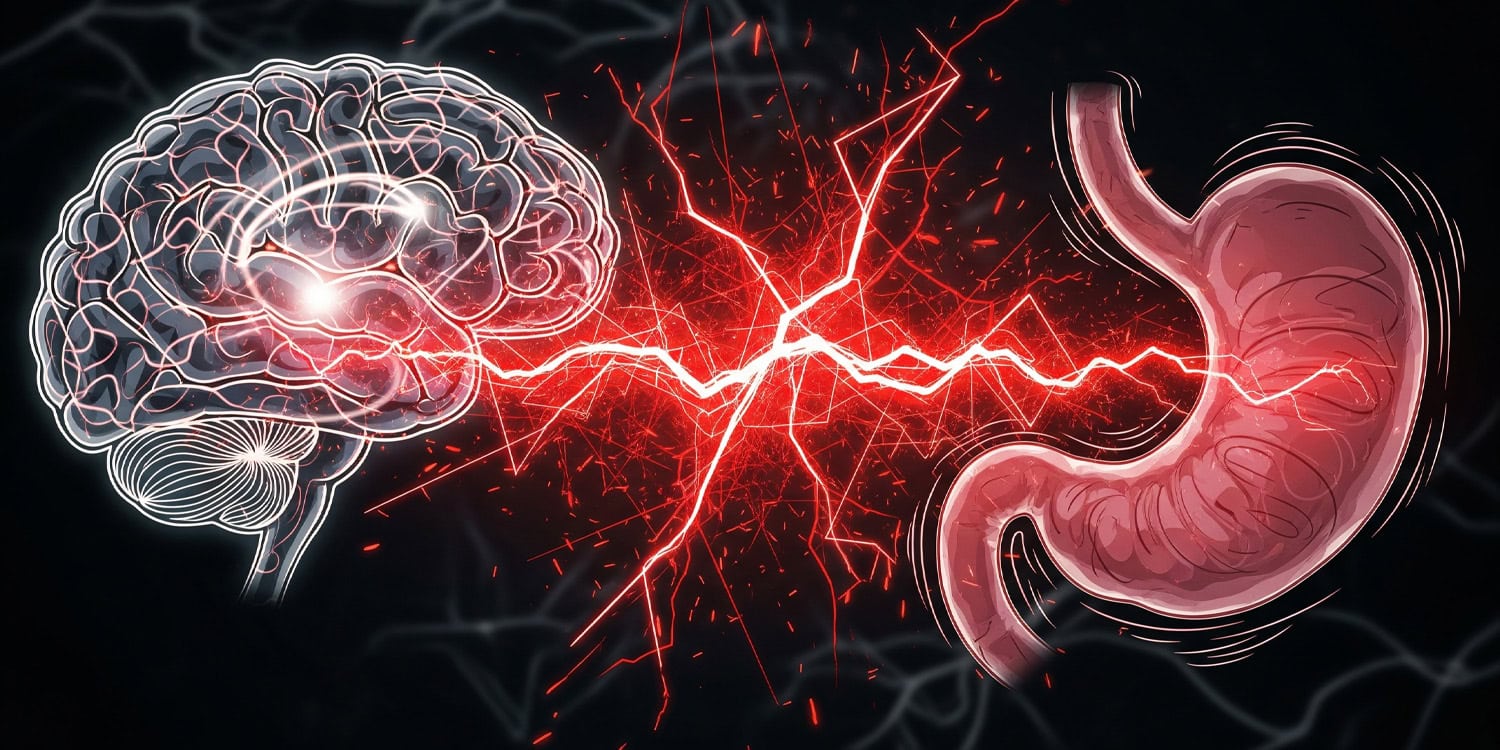
A new study provides evidence that the connection between the brain and the stomach may be linked to mental health in a measurable way. Researchers from Aarhus University in Denmark, publishing their work in Nature Mental Health, report that a specific pattern of communication between the brain and the stomach reflects how individuals feel emotionally and psychologically. Their findings suggest that these gut-brain interactions can indicate a person’s levels of anxiety, depression, well-being, and overall quality of life.
The idea that emotions are linked to physical sensations in the gut is widely reflected in language. People often talk about having “butterflies in the stomach” when nervous, or feeling “sick to the stomach” when distressed. Yet, despite these common expressions, most scientific attention in the field of brain-body interaction has focused on other organs, such as the heart and lungs. These areas have long been studied for their roles in emotion and mood.
The researchers were struck by how little was known about how the stomach, in particular, interacts with the brain. While recent studies have explored the influence of gut bacteria and digestion on mental health, very little work had been done on the electrical rhythms of the stomach and how they may directly communicate with the brain’s networks involved in emotion, attention, and cognition.
The team behind this new study wanted to explore whether a person’s psychological profile might be reflected in how strongly the stomach and brain are coupled during rest. Their aim was not to link a specific diagnosis like depression to a single brain region, but rather to identify patterns across a broad spectrum of mental health experiences.
“Our interest grew from the long-standing discussion about the role of the body in shaping emotion, a question that has fascinated philosophers and scientists for centuries,” said study author Leah Banellis (@leahbanellis), a postdoctoral fellow in Cognitive Neuroscience at Aarhus University. “Yet, while the heart and lungs have received much attention, the stomach has been largely overlooked. This gap struck us as especially surprising, because the link between the stomach and emotional experience feels so intuitive. It is heavily reflected in everyday language, with phrases like ‘butterflies in the stomach,’ ‘sick to our stomach,’ or ‘trust your gut.’”
The research was part of the Visceral Mind Project, a large-scale initiative that combines data on brain activity, bodily rhythms, and psychological assessments. The team recorded data from 243 people using a method that captures both electrical signals from the stomach (electrogastrography) and brain activity measured with functional magnetic resonance imaging (fMRI).
The participants represented a wide range of mental health profiles, from those reporting high well-being to others showing signs of distress, including anxiety, depression, fatigue, and insomnia. To capture this diversity, the researchers didn’t exclude people with psychiatric symptoms or diagnoses. Instead, they aimed for variation, which would allow their models to detect patterns across the mental health spectrum.
Each participant underwent a series of recordings while lying still in the MRI scanner. At the same time, sensors on the abdomen captured the stomach’s slow electrical rhythm, which cycles about three times per minute. This rhythm, which originates from specialized cells in the stomach lining, is typically involved in coordinating digestion. But the researchers suspected it might also be linked to mental state.
To analyze the relationship between stomach and brain activity, the team used a method that looks at how well the two rhythms align over time. This measure, known as phase-locking value, essentially captures the degree of synchronization between stomach signals and brain signals across different regions.
The researchers then combined this data with results from a comprehensive mental health questionnaire. The battery included 37 different scores across a range of domains—such as anxiety, stress, mood, fatigue, attention, sleep quality, and life satisfaction. Using a statistical method known as canonical correlation analysis, they looked for patterns that linked brain-stomach coupling with the participants’ mental health profiles.
The analysis revealed a clear and statistically significant pattern. Stronger coupling between the stomach’s rhythm and brain activity was associated with poorer mental health. Individuals who reported more symptoms of anxiety, depression, stress, and fatigue tended to show increased synchronization between their stomach and brain rhythms. In contrast, those with higher levels of well-being and life satisfaction showed weaker coupling.
“For the first time, we’ve found a scientific link between your ‘gut feelings’ and your mental health, showing a surprising connection between your stomach’s natural rhythm and your brain,” Banellis told PsyPost. “Specifically, our study revealed that stronger communication between the stomach and brain is linked to worse mental health, such as higher symptoms of anxiety, depression, stress, and fatigue, whereas weaker stomach-brain communication aligns with better mental health reflected in higher overall well-being and quality of life.”
This stomach-brain signature was not random. It was localized in specific brain networks, particularly those involved in attention, cognitive control, and salience detection. Some of the strongest associations were found in regions like the superior angular gyrus and the posterior frontal and parietal areas—regions often implicated in cognitive tasks and mental health disorders.
Importantly, the researchers ran multiple control analyses to ensure the robustness of their findings. They ruled out the possibility that the observed effects were simply due to general brain activity patterns, fluctuations in heart rate or breathing, or basic features of stomach physiology. In other words, the association appeared specific to the coupling between the stomach’s electrical rhythm and particular brain networks—not just a general marker of body or brain state.
Their approach was designed to detect broad psychological dimensions rather than focus on one diagnosis. The strongest psychological pattern they found was a spectrum ranging from negative affective states (like anxiety and depression) to positive traits (like well-being and quality of life). This result suggests that the stomach-brain connection is not tied to any one disorder but instead reflects a general mode of psychological functioning.
“Anxiety, depression, stress, and fatigue showed the strongest links to stomach-brain communication,” Banellis explained. “While phrases like ‘butterflies in the stomach’ or feeling ‘sick to your stomach’ are common ways we describe emotional distress, it was surprising to find such consistent and clear evidence across these symptoms. Even more unexpected was the direction of the effect: we might have assumed that stronger alignment between the body and brain would be beneficial. Instead, our findings suggest that heightened stomach-brain communication could act more like a warning signal, an internal alarm system reflecting mental strain rather than harmony.”
As with all research, there are limitations. The findings are based on resting-state measurements, meaning the participants were not performing any tasks during the brain scans. This leaves open the question of how the stomach-brain relationship behaves during emotional challenges or cognitive demands.
Another limitation is that the study was cross-sectional—it measured participants at one point in time. This limits the ability to determine cause and effect. Longitudinal studies that follow people over time will be needed to see whether changes in stomach-brain coupling can predict shifts in mental health, or whether interventions that alter this coupling can improve well-being.
“Despite our study including hundreds of participants, far surpassing the size of previous studies, and using a robust machine learning technique, our study is correlational in nature,” Banellis noted. “Thus, future causal paradigms are needed to understand this mental health associated stomach-brain relationship further.”
The researchers also note that their measurements relied on surface recordings of stomach activity, which can be affected by noise and variability. Despite extensive quality control, a portion of the data had to be excluded. Future studies using higher-resolution tools or invasive methods in clinical settings might yield even clearer signals.
“Our study raises important questions about causality, whether the stomach is influencing the brain, the brain is influencing the stomach, or both, as well as how stomach-brain communication develops over time and whether it can predict changes in mental health,” Banellis said. “It also opens the door to new treatment approaches targeting the disrupted brain-body connection we identified.”
“To build on these findings, we plan to pursue three closely connected next steps: first, case-controlled studies in patients diagnosed with anxiety or depression; second, longitudinal studies to track how stomach-brain communication evolves and whether it predicts mental health trajectories; and third, testing new interventions designed to modulate stomach-brain interactions and evaluate their potential for improving mental health.”
The study, “Stomach–brain coupling indexes a dimensional signature of mental health,” was authored by Leah Banellis, Ignacio Rebollo, Niia Nikolova, and Micah Allen.
link