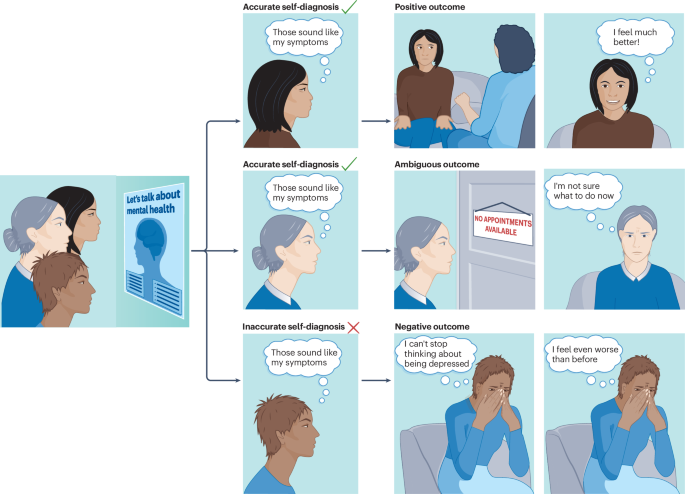
The psychological consequences of mental health awareness efforts
Hahn, J. S., Chua, K.-C., Jones, R. & Henderson, C. The Every Mind Matters campaign: changes in mental health literacy and its associations with campaign awareness. Eur. J. Public Health 33, 1008–1013 (2023).
Google Scholar
Henderson, C., Potts, L. & Robinson, E. J. Mental illness stigma after a decade of Time to Change England: inequalities as targets for further improvement. Eur. J. Public Health 30, 497–503 (2020).
Google Scholar
Hoover, S. & Bostic, J. Schools as a vital component of the child and adolescent mental health system. Psychiat. Serv. 72, 37–48 (2021).
Google Scholar
Lever, N. et al. Using the whole school, whole community, whole child model to support mental health in schools. J. Sch. Health 94, 200–203 (2024).
Google Scholar
March, A., Stapley, E., Hayes, D., Town, R. & Deighton, J. Barriers and facilitators to sustaining school-based mental health and wellbeing interventions: a systematic review. Int. J. Environ. Res. Public Health 19, 3587 (2022).
Google Scholar
Draganidis, A., Fernando, A. N., West, M. L. & Sharp, G. Social media delivered mental health campaigns and public service announcements: a systematic literature review of public engagement and help-seeking behaviours. Soc. Sci. Med. 359, 117231 (2024).
Google Scholar
Foulkes, L. & Andrews, J. L. Are mental health awareness efforts contributing to the rise in reported mental health problems? A call to test the prevalence inflation hypothesis. N. Ideas Psychol. 69, 101010 (2023).
Google Scholar
Booth, R. G., Allen, B. N., Bray Jenkyn, K. M., Li, L. & Shariff, S. Z. Youth mental health services utilization rates after a large-scale social media campaign: population-based interrupted time-series analysis. JMIR Ment. Health 5, e27 (2018).
Google Scholar
Durlak, J. A., Mahoney, J. L. & Boyle, A. E. What we know, and what we need to find out about universal, school-based social and emotional learning programs for children and adolescents: a review of meta-analyses and directions for future research. Psychol. Bull. 148, 765–782 (2022).
Google Scholar
Werner-Seidler, A. et al. School-based depression and anxiety prevention programs: an updated systematic review and meta-analysis. Clin. Psychol. Rev. 89, 102079 (2021).
Google Scholar
Ecclestone, K. Resisting images of the ‘diminished self’: the implications of emotional well-being and emotional engagement in education policy. J. Educ. Policy 22, 455–470 (2007).
Google Scholar
Wright, K. Student wellbeing and the therapeutic turn in education. Aust. Educ. Dev. Psychol. 31, 141–152 (2014).
Google Scholar
Cuijpers, P. Universal prevention of depression at schools: dead end or challenging crossroad? Evidence-based Ment. Health 25, 96–98 (2022).
Google Scholar
Foulkes, L. & Stringaris, A. Do no harm: can school mental health interventions cause iatrogenic harm? BJPsych Bull. 47, 267–269 (2023).
Google Scholar
Guzman-Holst, C., Streckfuss Davis, R., Andrews, J. L. & Foulkes, L. Scoping review: potential harm from school-based group mental health interventions. Child Adolesc. Ment. Health 30, 208–222 (2025).
Google Scholar
Kearney, C. A. The perniciousness and promise of school-based mental health service delivery for youth. Res. Child. Adolesc. Psychopathol. 53, 609–624 (2025).
Google Scholar
Beeker, T. et al. Psychiatrization of society: a conceptual framework and call for transdisciplinary research. Front. Psychiatry 12, 645556 (2021).
Google Scholar
Underhill, R. & Foulkes, L. Self-diagnosis of mental disorders: a qualitative study of attitudes on Reddit. Qual. Health Res. 35, 779–792 (2025).
Google Scholar
Lane, R. “He doesn’t really have bipolar …”. The rise of strategic essentialism and diagnostic possessiveness in bipolar disorder. SSM Ment. Health 5, 100299 (2024).
Google Scholar
Dakin, B. C., McGrath, M. J., Rhee, J. J. & Haslam, N. Broadened concepts of harm appear less serious. Soc. Psychol. Personal. Sci. 14, 72–83 (2023).
Google Scholar
Haslam, N. Concept creep: psychology’s expanding concepts of harm and pathology. Psychol. Inq. 27, 1–17 (2016).
Google Scholar
Tam, M. T., Wu, J. M., Zhang, C. C., Pawliuk, C. & Robillard, J. M. A systematic review of the impacts of media mental health awareness campaigns on young people. Health Prom. Pract. 25, 907–920 (2024).
Google Scholar
Walsh, D. A. B. & Foster, J. L. H. A call to action. A critical review of mental health related anti-stigma campaigns. Front. Public Health 8, 569539 (2021).
Google Scholar
Evans-Lacko, S., Corker, E., Williams, P., Henderson, C. & Thornicroft, G. Effect of the time to change anti-stigma campaign on trends in mental-illness-related public stigma among the English population in 2003–13: an analysis of survey data. Lancet Psychiatry 1, 121–128 (2014).
Google Scholar
Ronaldson, A. & Henderson, C. Investigating changes in mental illness stigma and discrimination after the Time To Change programme in England. BJPsych Open 10, e199 (2024).
Google Scholar
Reavley, N. J. & Jorm, A. F. Public recognition of mental disorders and beliefs about treatment: changes in Australia over 16 years. Br. J. Psychiatry 200, 419–425 (2012).
Google Scholar
Jorm, A. F., Christensen, H. & Griffiths, K. M. The impact of Beyond Blue: the national depression initiative on the Australian public’s recognition of depression and beliefs about treatments. Aust. NZ J. Psychiatry 39, 248–254 (2005).
Google Scholar
Donovan, R. J., Drane, C. F., Santini, Z. I. & Jalleh, G. Impact on help-seeking behaviours of a campaign perceived to decrease stigma and increase openness around mental health. Health Prom. J. Aust. 35, 1378–1385 (2024).
Google Scholar
Aftab, A. & Druss, B. G. Addressing the mental health crisis in youth — sick individuals or sick societies? JAMA Psychiatry 80, 863 (2023).
Google Scholar
Ahuvia, I. L. & Link, B. G. The mental illness self-labeling model: a conceptual model for studying the effects of mental-illness self-labeling on clinical outcomes. Clin. Psychol Sci. 13, 1031–1050 (2025).
Google Scholar
Bantjes, J., Hunt, X. & Stein, D. J. Anxious, depressed, and suicidal: crisis narratives in university student mental health and the need for a balanced approach to student wellness. Int. J. Environ. Res. Public Health 20, 4859 (2023).
Google Scholar
Coppock, V. Psychiatrised childhoods. Glob. Stud. Child. 10, 3–11 (2020).
Google Scholar
Corzine, A. & Roy, A. Inside the black mirror: current perspectives on the role of social media in mental illness self-diagnosis. Discov. Psychol. 4, 40 (2024).
Google Scholar
Malla, A. & Gold, I. Public discourse on mental health: a critical view. J. Psychiatry Neurosci. 49, E126–E131 (2024).
Google Scholar
Monteith, S. et al. Implications of online self-diagnosis in psychiatry. Pharmacopsychiatry 57, 45–52 (2024).
Google Scholar
Samuel, L., Kuijpers, K. & Bleakley, A. TherapyTok for depression and anxiety: a quantitative content analysis of high engagement Tiktok videos. J. Adolesc. Health 74, 1184–1190 (2024).
Google Scholar
Tsou, J. Y. Hacking on the looping effects of psychiatric classifications: what is an interactive and indifferent kind? Int. Stud. Phil. Sci. 21, 329–344 (2007).
Google Scholar
Coppock, V. Liberating the mind or governing the soul? Psychotherapeutic education, children’s rights and the disciplinary state. Educ. Inq. 2, 385–399 (2011).
Google Scholar
Foulkes, L. & Stapley, E. Want to improve school mental health interventions? Ask young people what they actually think. J. Phil. Educ. 56, 41–50 (2022).
Google Scholar
Frawley, A., Wakeham, C., McLaughlin, K. & Ecclestone, K. Constructing a crisis: mental health, higher education and policy entrepreneurs. Sociol. Res. Online 29, 351–369 (2024).
Google Scholar
Sullivan, G. M. & Feinn, R. Using effect size — or why the P value is not enough. J. Graduate Med. Educ. 4, 279–282 (2012).
Google Scholar
Grant, S. et al. Effectiveness of school-based depression prevention interventions: an overview of systematic reviews with meta-analyses on depression outcomes. J. Consult. Clin. Psychol. 93, 194–212 (2025).
Google Scholar
Hayes, D. et al. Universal, school-based, interventions to improve emotional outcomes in children and young people: a systematic review and meta-analysis. Front. Child Adolesc. Psychiatry 4, 1526840 (2025).
Google Scholar
Deighton, J. et al. Effectiveness of School Mental Health Awareness Interventions: Universal Approaches in English Secondary Schools (UK Department for Education, 2025).
Harvey, L. J., White, F. A., Hunt, C. & Abbott, M. Investigating the efficacy of a dialectical behaviour therapy-based universal intervention on adolescent social and emotional well-being outcomes. Behav. Res. Ther. 169, 104408 (2023).
Google Scholar
Kuyken, W. et al. Effectiveness and cost-effectiveness of universal school-based mindfulness training compared with normal school provision in reducing risk of mental health problems and promoting well-being in adolescence: the MYRIAD cluster randomised controlled trial. Evidence-based Ment. Health 25, 99–109 (2022).
Google Scholar
Andrews, J. L. et al. Evaluating the effectiveness of a universal eHealth school-based prevention programme for depression and anxiety, and the moderating role of friendship network characteristics. Psychol. Med. 53, 5042–5051 (2023).
Google Scholar
Foulkes, L., Andrews, J. L., Reardon, T. & Stringaris, A. Research recommendations for assessing potential harm from universal school-based mental health interventions. Nat. Ment. Health 2, 270–277 (2024).
Google Scholar
Bridgland, V. M. E., Jones, P. J. & Bellet, B. W. A meta-analysis of the efficacy of trigger warnings, content warnings, and content notes. Clin. Psychol. Sci. 12, 751–771 (2024).
Google Scholar
Miller, E. J., Crane, C., Medlicott, E., Robson, J. & Taylor, L. Non-positive experiences encountered by pupils during participation in a mindfulness-informed school-based intervention. Sch. Ment. Health 15, 851–872 (2023).
Google Scholar
Garmy, P., Berg, A. & Clausson, E. K. A qualitative study exploring adolescents’ experiences with a school-based mental health program. BMC Public Health 15, 1074 (2015).
Google Scholar
Lindholm, S. K. & Zetterqvist Nelson, K. “Apparently I’ve got low self-esteem”: schoolgirls’ perspectives on a school-based public health intervention. Child. Soc. 29, 473–483 (2015).
Google Scholar
Stapley, E. et al. A qualitative study of English school children’s experiences of two brief, universal, classroom-based mental health and wellbeing interventions: mindfulness and relaxation. Contemp. School Psychol. (2025).
Ahuvia, I. L. Refining the prevalence inflation hypothesis: disentangling overinterpretation from self-fulfilling prophecies. N. Ideas Psychol. 75, 101106 (2024).
Google Scholar
Ndour, A. & Foulkes, L. The romanticisation of mental health problems in adolescents and its implications: a narrative review. Eur. Child. Adolesc. Psychiatry 34, 2297–2326 (2025).
Google Scholar
Acheson, R. & Papadima, M. The search for identity: working therapeutically with adolescents in crisis. J. Child. Psychother. 49, 95–119 (2023).
Google Scholar
Chan, D. & Sireling, L. ‘I want to be bipolar’…a new phenomenon. Psychiatrist 34, 103–105 (2010).
Google Scholar
Fellowes, S. Self-diagnosis in psychiatry and the distribution of social resources. R. Inst. Phil. Suppl. 94, 55–76 (2023).
Google Scholar
Haslam, N. & Tse, J. S. Public awareness of mental illness: mental health literacy or concept creep? Australasian Psychiatry 33, 18–20 (2025).
Google Scholar
Rutter, L. A. et al. “I haven’t been diagnosed, but I should be” — insight into self-diagnoses of common mental health disorders: cross-sectional study. JMIR Form. Res. 7, e39206 (2023).
Google Scholar
Brinkmann, S. Languages of suffering. Theory Psychol. 24, 630–648 (2014).
Google Scholar
David, A. S. & Deeley, Q. Dangers of self-diagnosis in neuropsychiatry. Psychol. Med. 54, 1057–1060 (2024).
Google Scholar
Hofmann, B., Reid, L., Carter, S., Rogers, W. et al. Overdiagnosis, one concept, three perspectives, and a model. Eur. J. Epidemiol. 36, 655–656 (2021).
Google Scholar
Hasan, F., Foster, M. M. & Cho, H. Normalizing anxiety on social media increases self-diagnosis of anxiety: the mediating effect of identification (but not stigma). J. Health Commun. 28, 563–572 (2023).
Google Scholar
Jones, P. J. & McNally, R. J. Does broadening one’s concept of trauma undermine resilience? Psychol. Trauma 14, S131–S139 (2022).
Google Scholar
Hardman, C. A. et al. “Food addiction is real”. The effects of exposure to this message on self-diagnosed food addiction and eating behaviour. Appetite 91, 179–184 (2015).
Google Scholar
Sandra, D. A. et al. Inform and do no harm: nocebo education reduces false self-diagnosis caused by mental health awareness. Psychol. Med. 55, e330 (2025).
Google Scholar
Merckelbach, H., Jelicic, M. & Pieters, M. Misinformation increases symptom reporting: a test–retest study. JRSM Short Rep. 2, 1–6 (2011).
Google Scholar
Van Helvoort, D., Otgaar, H. & Merckelbach, H. Worsening of self-reported symptoms through suggestive feedback. Clin. Psychol. Sci. 8, 359–365 (2020).
Google Scholar
Jelicic, M., Frederix, M. & Merckelbach, H. Brief report: writing about chronic fatigue increases somatic complaints. Psychol. Top. 22, 405–412 (2013).
Whitted, W. M. et al. Seeing is believing: the effect of subtle communication in social media on viewers’ beliefs about depression and anxiety symptom trajectories. J. Clin. Psychol. 80, 1050–1064 (2024).
Google Scholar
Kemp, J. J., Lickel, J. J. & Deacon, B. J. Effects of a chemical imbalance causal explanation on individuals’ perceptions of their depressive symptoms. Behav. Res. Ther. 56, 47–52 (2014).
Google Scholar
Ruddock, H. K. et al. Believing in food addiction: helpful or counterproductive for eating behavior? Obesity 24, 1238–1243 (2016).
Google Scholar
Siegel, J. T., Flores-Medel, E., Martinez, D. A. & Berger, D. E. Can mental health anti-stigma messages have untoward effects on some people with depression?: an exploratory study. J. Health Commun. 24, 821–828 (2019).
Google Scholar
Dolan, P., Hallsworth, M., Halpern, D., King, D. & Vlaev, I. MINDSPACE: Influencing Behaviour for Public Policy (Institute for Government, 2010).
Dolan, P. et al. Influencing behaviour: the mindspace way. J. Econ. Psychol. 33, 264–277 (2012).
Google Scholar
Kassin, S. M. Deposition testimony and the surrogate witness: evidence for a ‘messenger effect’ in persuasion. Personal. Soc. Psychol. Bull. 9, 281–288 (1983).
Google Scholar
Rooney, T., Sharpe, L., Todd, J., Richmond, B. & Colagiuri, B. The relationship between expectancy, anxiety, and the nocebo effect: a systematic review and meta-analysis with recommendations for future research. Health Psychol. Rev. 17, 550–577 (2023).
Google Scholar
Stein, M. V., Heller, M., Chapman, S., Rubin, G. J. & Terhune, D. B. Trait responsiveness to verbal suggestions predicts nocebo responding: a meta-analysis. Br. J. Health Psychol. 30, e12774 (2025).
Google Scholar
Marcotulli, D., Foulkes, L. & Stringaris, A. Editorial perspective: how spreading mental health information can be (un-) helpful — a dynamic systems approach. Child Psychol. Psychiatry (2025).
Ormel, J., Hollon, S. D., Kessler, R. C., Cuijpers, P. & Monroe, S. M. More treatment but no less depression: the treatment-prevalence paradox. Clin. Psychol. Rev. 91, 102111 (2022).
Google Scholar
Saunders, R. et al. Effectiveness of psychological interventions for young adults versus working age adults: a retrospective cohort study in a national psychological treatment programme in England. Lancet Psychiatry 12, 650–659 (2025).
Google Scholar
Sawyer, S. M., Azzopardi, P. S., Wickremarathne, D. & Patton, G. C. The age of adolescence. Lancet Child Adolesc. Health 2, 223–228 (2018).
Google Scholar
Erikson, E. H. Identity, Youth and Crisis (W. W. Norton, 1968).
Sebastian, C., Burnett, S. & Blakemore, S.-J. Development of the self-concept during adolescence. Trends Cogn. Sci. 12, 441–446 (2008).
Google Scholar
Munawar, K., Kuhn, S. K. & Haque, S. Understanding the reminiscence bump: a systematic review. PLoS ONE 13, e0208595 (2018).
Google Scholar
McAdams, D. P. Narrative identity: what is it? what does it do? how do you measure it? Imag. Cogn. Personal. 37, 359–372 (2018).
Google Scholar
Granic, I., Morita, H. & Scholten, H. Beyond screen time: identity development in the digital age. Psychol. Inq. 31, 195–223 (2020).
Google Scholar
Foster, A. & Ellis, N. TikTok-inspired self-diagnosis and its implications for educational psychology practice. Educ. Psychol. Pract. 40, 491–508 (2024).
Google Scholar
O’Connor, C., Kadianaki, I., Maunder, K. & McNicholas, F. How does psychiatric diagnosis affect young people’s self-concept and social identity? A systematic review and synthesis of the qualitative literature. Soc. Sci. Med. 212, 94–119 (2018).
Google Scholar
Farnood, A., Johnston, B. & Mair, F. S. A mixed methods systematic review of the effects of patient online self-diagnosing in the ‘smart-phone society’ on the healthcare professional–patient relationship and medical authority. BMC Med. Inf. Decis. Mak. 20, 253 (2020).
Google Scholar
Harness, J. & Getzen, H. TikTok’s sick-role subculture and what to do about it. J. Am. Acad. Child Adolesc. Psychiatry 61, 351–353 (2021).
Google Scholar
McGrath, J. J. et al. Age of onset and cumulative risk of mental disorders: a cross-national analysis of population surveys from 29 countries. Lancet Psychiatry 10, 668–681 (2023).
Google Scholar
Casey, B. J. et al. The storm and stress of adolescence: insights from human imaging and mouse genetics. Dev. Psychobiol. 52, 225–235 (2010).
Google Scholar
Silvers, J. A. Adolescence as a pivotal period for emotion regulation development. Curr. Opin. Psychol. 44, 258–263 (2022).
Google Scholar
Steare, T., Gutiérrez Muñoz, C., Sullivan, A. & Lewis, G. The association between academic pressure and adolescent mental health problems: a systematic review. J. Affect. Disord. 339, 302–317 (2023).
Google Scholar
Foulkes, L., Leung, J. T., Fuhrmann, D., Knoll, L. J. & Blakemore, S.-J. Age differences in the prosocial influence effect. Dev. Sci. 21, e12666 (2018).
Google Scholar
Knoll, L. J., Magis-Weinberg, L., Speekenbrink, M. & Blakemore, S.-J. Social influence on risk perception during adolescence. Psychol. Sci. 26, 583–592 (2015).
Google Scholar
Alho, J. et al. Transmission of mental disorders in adolescent peer networks. JAMA Psychiatry 81, 882 (2024).
Google Scholar
Rooney, T., Sharpe, L., Todd, J., Tang, B. & Colagiuri, B. The nocebo effect across health outcomes: a systematic review and meta-analysis. Health Psychol. 43, 41–57 (2023).
Google Scholar
Ehlers, A., Margraf, J., Roth, W. T., Taylor, C. B. & Birbaumer, N. Anxiety induced by false heart rate feedback in patients with panic disorder. Behav. Res. Ther. 26, 1–11 (1988).
Google Scholar
Pauli, P. et al. Anxiety induced by cardiac perceptions in patients with panic attacks: a field study. Behav. Res. Ther. 29, 137–145 (1991).
Google Scholar
Story, T. J. & Craske, M. G. Responses to false physiological feedback in individuals with panic attacks and elevated anxiety sensitivity. Behav. Res. Ther. 46, 1001–1008 (2008).
Google Scholar
Wild, J., Clark, D. M., Ehlers, A. & McManus, F. Perception of arousal in social anxiety: effects of false feedback during a social interaction. J. Behav. Ther. Exp. Psychiatry 39, 102–116 (2008).
Google Scholar
Lazarov, A., Dar, R., Liberman, N. & Oded, Y. Obsessive–compulsive tendencies and undermined confidence are related to reliance on proxies for internal states in a false feedback paradigm. J. Behav. Ther. Exp. Psychiatry 43, 556–564 (2012).
Google Scholar
Makkar, S. R. & Grisham, J. R. Effects of false feedback on affect, cognition, behavior, and postevent processing: the mediating role of self-focused attention. Behav. Ther. 44, 111–124 (2013).
Google Scholar
Hacking, I. in Causal Cognition (eds Sperber, D. et al.) 351–383 (Oxford Univ. Press, 1996).
Link, B. G., Cullen, F. T., Struening, E., Shrout, P. E. & Dohrenwend, B. P. A modified labeling theory approach to mental disorders: an empirical assessment. Am. Sociol. Rev. 54, 400 (1989).
Google Scholar
Scheff, T. J. The labelling theory of mental illness. Am. Sociol. Rev. 39, 444 (1974).
Google Scholar
Ecclestone, K. & Hayes, D. The Dangerous Rise of Therapeutic Education (Routledge, 2009).
Corneille, O. & Lush, P. Sixty years after Orne’s American Psychologist article: a conceptual framework for subjective experiences elicited by demand characteristics. Personal. Soc. Psychol. Rev. 27, 83–101 (2023).
Google Scholar
Iarygina, O., Hornbæk, K. & Mottelson, A. Demand characteristics in human–computer experiments. Int. J. Human–Computer Stud. 193, 103379 (2025).
Google Scholar
Nichols, A. L. & Maner, J. K. The good-subject effect: investigating participant demand characteristics. J. Gen. Psychol. 135, 151–166 (2008).
Google Scholar
Orne, M. T. On the social psychology of the psychological experiment: with particular reference to demand characteristics and their implications. Am. Psychol. 17, 776–783 (1962).
Google Scholar
Ju, R., Jia, M. & Cheng, J. Promoting mental health on social media: a content analysis of organizational tweets. Health Commun. 38, 1540–1549 (2023).
Google Scholar
Saha, K. et al. A computational study of mental health awareness campaigns on social media. Transl. Behav. Med. 9, 1197–1207 (2019).
Google Scholar
Milton, A., Ajmani, L., DeVito, M. A. & Chancellor, S. “I see me here”: mental health content, community, and algorithmic curation on TikTok. In Proc. 2023 CHI Conf. Human Factors in Computing Systems (eds Schmidt, A. et al.) 480 (ACM, 2023).
Montero-Marin, J. et al. School-based mindfulness training in early adolescence: what works, for whom and how in the MYRIAD trial? Evidence-based Ment. Health 25, 117–124 (2022).
Google Scholar
Stallard, P. et al. Classroom based cognitive behavioural therapy in reducing symptoms of depression in high risk adolescents: pragmatic cluster randomised controlled trial. BMJ 345, e6058 (2012).
Google Scholar
Bonell, C., Jamal, F., Melendez-Torres, G. J. & Cummins, S. ‘Dark logic’: theorising the harmful consequences of public health interventions. J. Epidemiol. Community Health 69, 95–98 (2015).
Google Scholar
Guttman, N. & Salmon, C. T. Guilt, fear, stigma and knowledge gaps: ethical issues in public health communication interventions. Bioethics 18, 531–552 (2004).
Google Scholar
Stratil, J. M., Baltussen, R., Scheel, I., Nacken, A. & Rehfuess, E. A. Development of the WHO-INTEGRATE evidence-to-decision framework: an overview of systematic reviews of decision criteria for health decision-making. Cost. Eff. Resour. Alloc. 18, 8 (2020).
Google Scholar
Kirsch, I. Response expectancy as a determinant of experience and behavior. Am. Psychol. 40, 1189–1202 (1985).
Google Scholar
Kirsch, I. Response expectancy and the placebo effect. Int. Rev. Neurobiol. 138, 81–93 (2018).
Google Scholar
Kirsch, I. Response expectancy theory and application: a decennial review. Appl. Prevent. Psychol. 6, 69–79 (1997).
Google Scholar
Crichton, F., Chapman, S., Cundy, T. & Petrie, K. J. The link between health complaints and wind turbines: support for the nocebo expectations hypothesis. Front. Public Health 2, 220 (2014).
Google Scholar
Crichton, F. & Petrie, K. J. Accentuate the positive: counteracting psychogenic responses to media health messages in the age of the internet. J. Psychosom. Res. 79, 185–189 (2015).
Google Scholar
Crichton, F. & Petrie, K. J. Health complaints and wind turbines: the efficacy of explaining the nocebo response to reduce symptom reporting. Environ. Res. 140, 449–455 (2015).
Google Scholar
Frey, J., Black, K. J. & Malaty, I. A. TikTok Tourette’s: are we witnessing a rise in functional tic-like behavior driven by adolescent social media Use? PRBM 15, 3575–3585 (2022).
Google Scholar
Zea Vera, A. et al. The phenomenology of tics and tic-like behavior in TikTok. Pediatric Neurol. 130, 14–20 (2022).
Google Scholar
Fremer, C. et al. Mass social media-induced illness presenting with Tourette-like behavior. Front. Psychiatry 13, 963769 (2022).
Google Scholar
Müller-Vahl, K. R., Pisarenko, A., Jakubovski, E. & Fremer, C. Stop that! It’s not Tourette’s but a new type of mass sociogenic illness. Brain 145, 476–480 (2022).
Google Scholar
Niesten, I. J. M., Merckelbach, H., Dandachi-FitzGerald, B. & Jelicic, M. The iatrogenic power of labeling medically unexplained symptoms: a critical review and meta-analysis of ‘diagnosis threat’ in mild head injury. Psychol. Conscious. 10, 454–474 (2023).
Renwick, L. et al. Mental health literacy in children and adolescents in low- and middle-income countries: a mixed studies systematic review and narrative synthesis. Eur. Child Adolesc. Psychiatry 33, 961–985 (2024).
Google Scholar
Van Den Broek, M. et al. Interventions to increase help-seeking for mental health care in low- and middle-income countries: a systematic review. PLoS Glob. Public Health 3, e0002302 (2023).
Google Scholar
Clay, J., Eaton, J., Gronholm, P. C., Semrau, M. & Votruba, N. Core components of mental health stigma reduction interventions in low- and middle-income countries: a systematic review. Epidemiol. Psychiat. Sci. 29, e164 (2020).
Google Scholar
Nwokoroku, S. C., Neil, B., Dlamini, C. & Osuchukwu, V. C. A systematic review of the role of culture in the mental health service utilisation among ethnic minority groups in the United Kingdom. Glob. Ment. Health 9, 84–93 (2022).
Google Scholar
Eylem, O. et al. Stigma for common mental disorders in racial minorities and majorities a systematic review and meta-analysis. BMC Public. Health 20, 879 (2020).
Google Scholar
Kapadia, D. Stigma, mental illness & ethnicity: time to centre racism and structural stigma. Sociol. Health Illness 45, 855–871 (2023).
Google Scholar
link