Understanding the impact of technology usage at work on academics’ psychological well-being: a perspective of technostress | BMC Psychology

Technostress and techno-stressors
Technostress describes individuals’ psychological and physiological reactions due to their perception that they cannot handle ICT demands effectively in the work [14, 20]. It is usually considered the ‘dark-side’ of ICT usage [21,22,23,24]. People who have to use technology frequently and heavily in their work are likely be exposed to technostress, especially among accountings [25], teleworkers [26–27] and academics [2, 6].
Techno-stressors are the variables creating technostress, which were used to examine the inducing conditions of technostress in an organization [11]. Some other scholars used the term “technostress creators” to describe techno-stressors [13, 14, 28]. They are stimuli or demands caused by ICT use [7, 16]. A number of researchers [16, 29] agreed that there are five typical techno-stressors: techno-overload, techno-complexity, techno-invasion, techno-insecurity, and techno-uncertainty. In this study, techno-overload describes the situations where academics are compelled to work longer and faster due to increased work demands accompanied by the ICT usage. Techno-complexity concerns the situations where academics are pushed to learn new knowledge and skills to keep up with the demand of work due to the increasing complexity or fast-changing of work-related ICT. Techno-invasion describes the situations where academics are forced to keep constant connectivity with work because of ICT and, consequently, their personal lives being invaded by work. Techno-insecurity concerns the situations where academics feel insecure about their work and get worried about being replaced by new intelligent technologies or those proficient in them. Techno-uncertainty describes the situations where ICT’s continuous changes and updates at workplace make academics unsettling. With the refreshing and updating of ICT, academics have to learn/relearn to keep pace with ICT development because their knowledge and skills may become obsolete.
From a holistic perspective, previous studies reported technostress’s negative consequences. For instance, technostress was found negatively linked with continuance intention toward a given technology [5, 9, 19], well-being [2, 15], and work performance or productivity [12, 20, 30, 31], leading to turnover intention [32–33]. For instance, Elemam et al. found that technostress was significantly correlated with the mental health of caregivers of primary and secondary school children [34]. With 168 teachers in Region of Murcia, Pagán-Garbín et al. confirmed statistically significant relationships between technostress and emotional exhaustion [35]. Duong et al. reported that technostress negatively influences life satisfaction [36]. However, regarding the effects of specific techno-stressors, previous research findings are inconsistent and even conflicting. For instance, several studies [14, 28] found that some techno-stressors predict work performance positively, while others predict it negatively. Califf and Brooks reported that techno-complexity and techno-uncertainty’s impact on burnout is insignificant, while the impact of the remaining three techno-stressors is significant and positive [7]. However, as far as we know, there is no research exploring the impact of techno-stressors on psychological well-being among academics in higher education organizations.
ICT self-efficacy and techno-stressors
Self-efficacy is a core concept of social cognitive theory, which reflects an individual’s confidence in accomplishing a specific goal [37, 38]. As a domain-specific self-efficacy, ICT self-efficacy refers to individuals’ judgment of their ability to use technology to execute an action [8]. Individuals with insufficient ICT self-efficacy may be anxious about new technology and unwilling to get involved [39]. Undoubtedly, an individual with sufficient ICT self-efficacy will experience less technostress. For instance, employees and salespersons with higher levels of computer self-efficacy have lower levels of technostress when implementing computers [40]. Physicians’ ICT self-efficacy is negatively associated with their technostress related to mobile electronic medical records usage [41].
For teachers, ICT self-efficacy is one of the most significant personal variables influencing academic staff’s attitudes and acceptance of technology usage in their professional life [42]. Scholars argued that developing individuals’ ICT self-efficacy and improving information systems (IS) literacy can cope with negative outcomes caused by techno- stressors [24]. Past studies have also confirmed the negative association between teachers’ self-efficacy and technostress. For instance, K-12 in-service teachers’ computer self-efficacy negatively correlates with their technostress [8]. Furthermore, university teachers’ self-efficacy in delivering effective online instruction can significantly alleviate their technostress [5]. Truța et al. also found that university teachers’ technology self-efficacy significantly and negatively predicts their technostress related to technology usage at work [2]. Although no research has concerned the effect of ICT self-efficacy on specific techno-stressors, we also expected a negative association between them based on the literature above. Academics with high ICT self-efficacy may be more likely to view technical events, such as ICT upgrades or the introduction of new technologies, as challenges and opportunities. They are convinced that they can effectively cope with the techno-stressors such as overload and complexity through their efforts. Thus, this study formulated the following hypotheses:
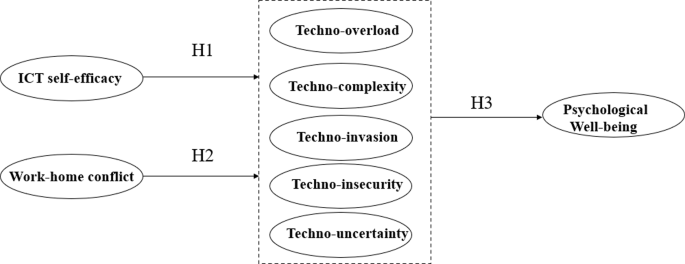
H1 ICT self-efficacy is negatively associated with techno-stressors among academics
H1a ICT self-efficacy is negatively associated with techno-overload among academics.
H1b ICT self-efficacy is negatively associated with techno-complexity among academics.
H1c ICT self-efficacy is negatively associated with techno-invasion among academics.
H1d ICT self-efficacy is negatively associated with techno-insecurity among academics.
H1e ICT self-efficacy is negatively associated with techno-uncertainty among academics.
Work-home conflict and techno-stressors
Work-home conflict describes the role conflict due to the demands from work and home domains [43], which is a crucial predictor of technostress [3]. According to the role theory [44], multiple roles requiring a large amount of demands, especially opposing ones, are likely to cause conflicts, such as work-home conflict. Researchers found that work-home conflicts stress individuals, deplete their mental assets, lower their life satisfaction [45], and even make them quit their positions [46]. The life of academics is often composed of multiple roles within and outside organization, such as teachers, researchers, professionals, and parents. To complete work tasks and achieve professional growth, telework and increased working hours are common things for them [2]. For instance, it is not easy for some of them to develop digital teaching materials (e.g., exquisite PowerPoint slides). Handling multiple tasks simultaneously may be a common occurrence. Since each person has a finite amount of energy and resources, academics may face a high risk of work-home conflict. However, work-home conflict implies the imbalance between work and family life, which can significantly raise the level of strain [47]. Faced with numerous responsibilities, the time used to fulfill the ICT demands from work will be compromised, consequently, the perceptions of techno-stressors increased. In this regard, this study proposed the following hypotheses:
H2 Work-home conflict is positively associated with techno-stressors among academics
H2a Work-home conflict is positively associated with techno-overload among academics.
H2b Work-home conflict is positively associated with techno-complexity among academics.
H2c Work-home conflict is positively associated with techno-invasion among academics.
H2d Work-home conflict is positively associated with techno-insecurity among academics.
H2e Work-home conflict is positively associated with techno-uncertainty among academics.
Techno-stressors and psychological well-being
Psychological well-being is a crucial indicator to evaluate human progress, broadly defined as an individual’s positive judgment of life and feeling satisfied [2]. Individuals with a high level of psychological well-being at work are likely to feel that work brings them satisfaction combined with enthusiasm, joy, excitement, and relaxation [48]. It is found that an individual’s subjective well-being can be impacted by a wide range of variables, including personality traits, physical status, personal and family life, material conditions and consumption, a fulfilling family life, personal and family health, and work-related issues [49].
Academics’ psychological well-being has attracted increasing concern because it is important for them to perform both teaching and research activities successfully. In the workplace, individuals exposed to work-related stressors are likely to get more dissatisfaction and negative effectivity [50]. Technostress resulting from the new changes of working is negatively linked with employees’ job-related well-being [51]. For instance, with a sample of 451 teleworkers, Fernández-Fernández et al. empirically confirmed that higher technostress predicts higher anxiety and lower satisfaction significantly [52].
Techno-stressors can create multiple psychological problems, such as fatigue, anxiety, burnout, depression and irritability, which are all negatively linked with individuals’ psychological well-being [53–54]. For instance, Asad et al. examined the relationship between techno-stressors and psychological well-being among postgraduates in Pakistan [18]. They found that all the five techno-stressors have a significant impact on learners’ psychological well-being, with the impact of techno-insecurity being moderate, while the impact of the other four techno-stressors is weak. In this regard, this study proposed the following hypotheses:
H3 techno-stressors is negatively associated with academics’ well-being
H3a Techno-overload is negatively associated with academics’ well-being.
H3b Techno-complexity is negatively associated with academics’ well-being.
H3c Techno-invasion is negatively associated with academics’ well-being.
H3d Techno-insecurity is negatively associated with academics’ well-being.
H3e Techno-uncertainty is negatively associated with academics’ well-being.
The proposed research model of this study was shown in Fig. 1.
link